Digging out
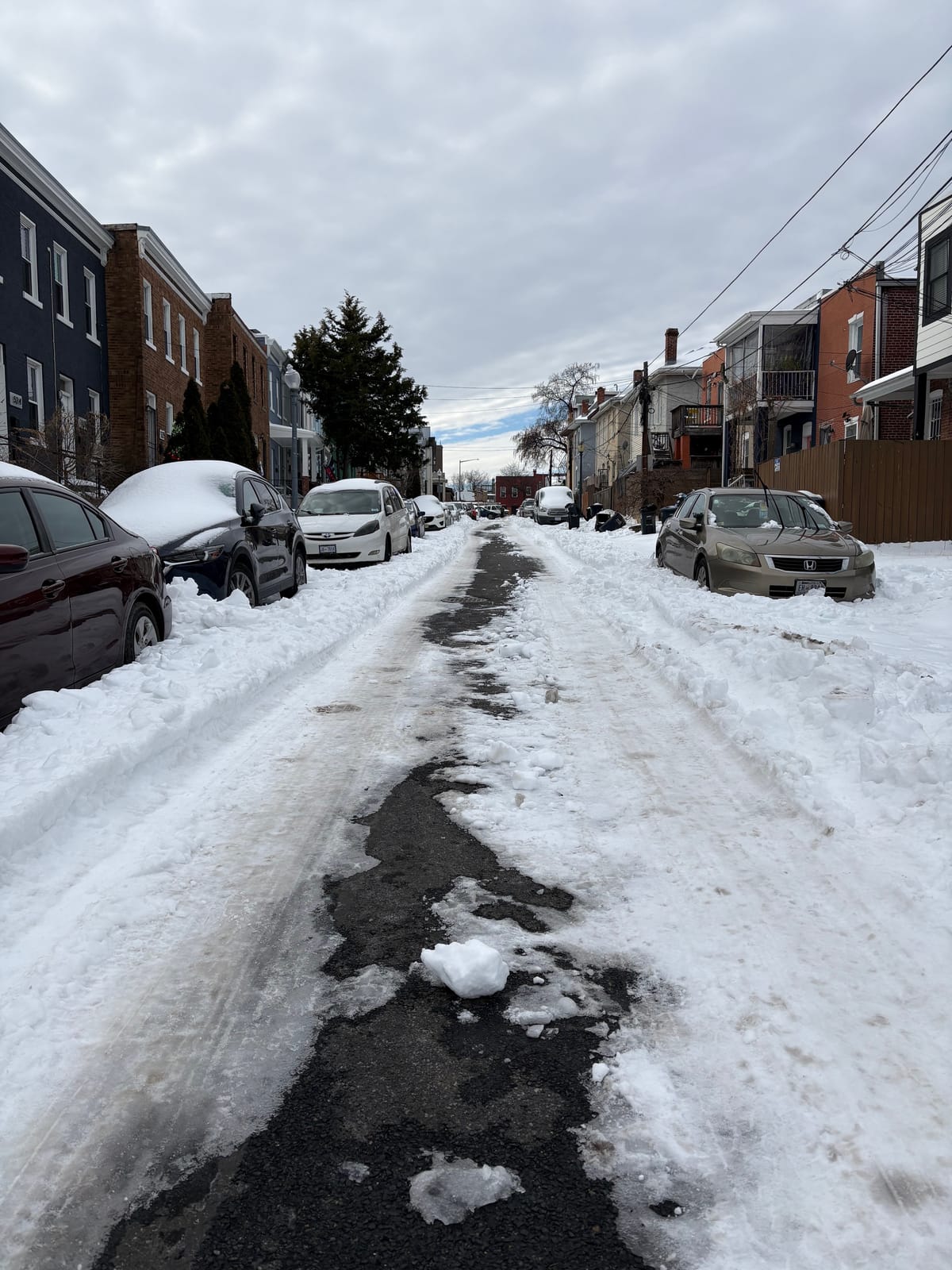
I helped dig two stuck cars out on my block Tuesday. I didn’t know, and had never before met, either driver.
One was a pest control worker, who had tried to veer his truck into the alley to avoid pedestrians walking down the street — the only passable corridor, with sidewalks mostly unshoveled — and had become stuck in the ice. I had been passing by, but went back to my house to grab a couple shovels. The two of us worked, while one of my neighbors I’d never met stood by and tried to help push each time the driver attempted to get some traction. After a few rounds, spanning 10 or 15 minutes, we got him free and on his way.
A few hours later, another neighbor I’d never met was trying to escape the parking spot behind my car after digging his minivan most of the way out. I could hear him spinning the tires from inside; I threw on my coat and boots, again, and headed out with my shovel. Along with one of his friends or family members — perhaps another neighbor, not someone I recognized — we freed him in a few minutes.
Earlier in the day, I had gone exploring around our severely underplowed neighborhood, in this city that already does not deal well with weather, and has been completely overwhelmed by a several-inch thick sheet of ice that coalesced on top of six inches of already fallen snow on Sunday. It’s all so frozen solid that I can walk along the top of it without cracking the shell, a curling sheet laid atop the whole city. I was trying to figure out a viable route to walk our daughter to daycare, which finally reopened Wednesday. There wasn’t one.
As I got a couple blocks out, I realized there was a bus stuck in the ice. It had tried to make a very routine turn up a hill, but the road hadn’t been plowed clearly enough for its wide wheelbase to navigate. When I came back 10 minutes later, another bus had come to relieve it, but had tried to take an alternate turn up the same hill, and had met the same fate. Now, both were blocking the two possible ways for cars to matriculate down what is normally a fairly busy stretch of road. Understandably frustrated drivers were intermittently expressing themselves through their horns.
When I looked back a half hour later, a third bus was stopped behind the other two.
This week has highlighted two of my growing concerns, both of which are featured heavily in the novel I’ve continued to plug away at — that we never learned any of the lessons of the pandemic, and that our social structures are hanging on by the barest of threads. When our mayor was first asked about when the city would reopen after the storm, she said “Tuesday.” Indeed, city offices were open Tuesday, despite all the impassable sidewalks, roads so jammed up they were stalling out snowplows, and main bike arteries left entirely unattended.
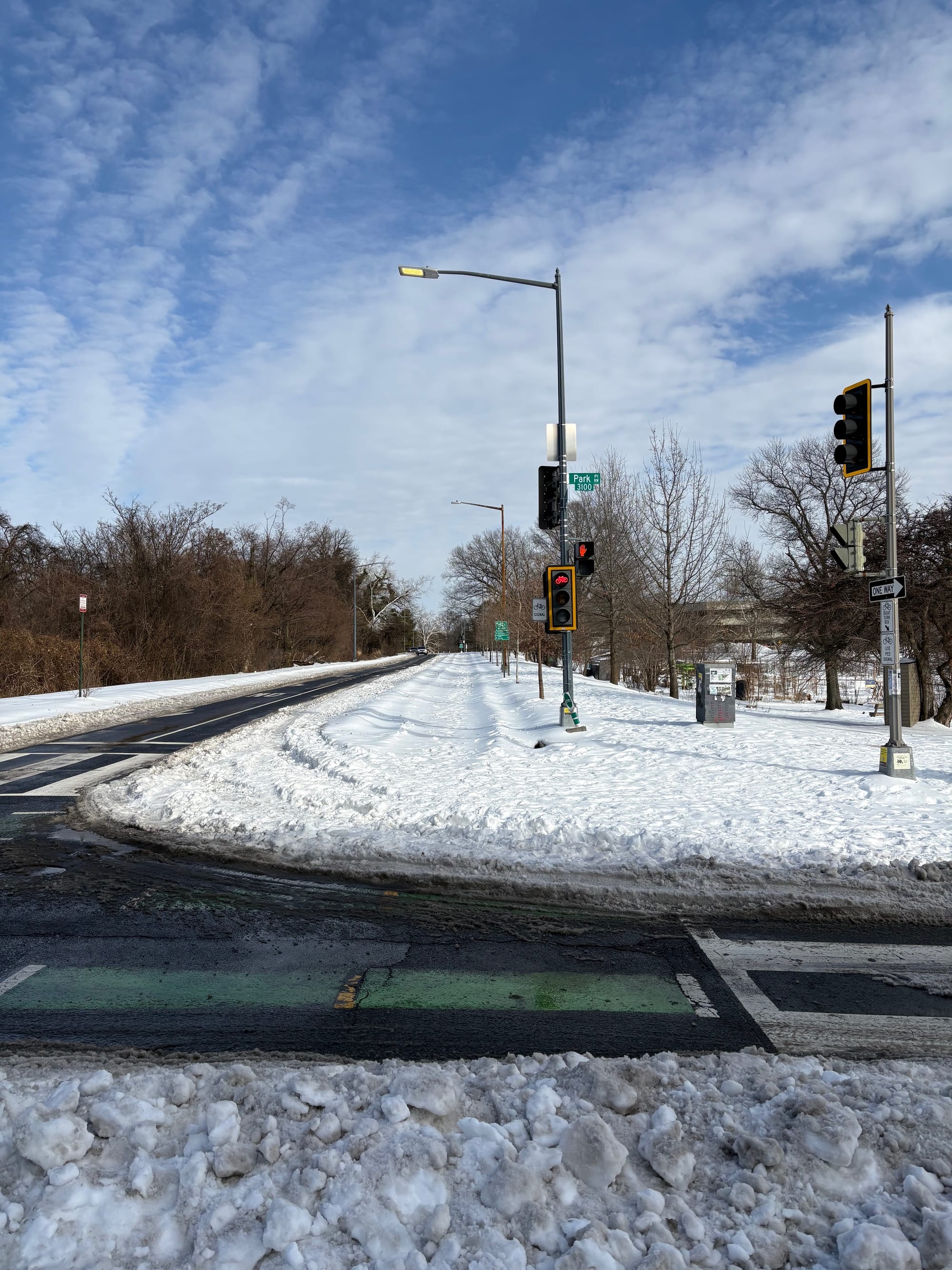
The only things that seem to work appear to do so because normal, everyday people are willing to stop what they’re doing and step in to help.
The trash, whose twice weekly pickups have already become more sporadic in recent months, can’t make it up the alley until it’s cleared of all the ice. Considering the road has barely been plowed enough for a car to navigate, we have no idea when that might be. Even if we took the hour or two it would take to fully extract our car, it probably wouldn’t be worth it to drive to the store for food. We’re still fairly well stocked; we can trudge out on foot, if need be, to a corner store for odds and ends to get by. It’s one of the great privileges of living in a city, where the car dependency that shapes so much of American life has a softer grip.
Still, the 10-day forecast is bleak. It won’t get back above freezing until after the weekend, which may bring more snow. And even then, just barely. We’ve also got a literal river of shit that’s been flowing into the Potomac for a week. There is no help coming from above for the foreseeable future. It’s going to be on us to take care of ourselves and our neighbors.
On Monday, we paid the kids going door-to-door 40 bucks, not to shovel our walk, which I’d already done, but for the three doors down to the alley, to make sure neighbors could get in and out. One of them was out there without gloves, so my wife gave her one of her sets and told her to keep them. She certainly needed them more.
Things could be a lot worse. We know this, because we have social media, and because we have eyes. I also have friends and family all over Minneapolis, people close to me whose lives have unfolded in prior months or years at the intersections now appearing in your trending tab.
When the earlier incarnation of the current offensive was in our city, it wasn’t yet fully masked, and militarized, and shooting people in the street. I haven’t published anything since then, but not because I haven’t been writing. Just because it hasn’t felt worth publishing anything else I’ve been writing, because of everything else going on. After all, reports are floating around that they are here, still, even plucking up people trying to work snow removal.
For my part, I promise I’ll start publishing more, soon enough. But not because everything will magically, somehow, be alright.
There’s a willful ignorance in our city leadership that we see among leadership across the country, a failure to acknowledge what is so painfully obvious: that ice won’t just take care of itself. That we can’t just wait for the next sunny day and this will all go away, back to normal. That we’re going to have to do the real, hard, backbreaking, ugly work of smashing it to pieces and hauling it off where it belongs, then the even harder work of figuring out the systems and protocols and people that need to be educated in all the ways to ensure that, if it ever threatens to come back — as history suggests it will — we’ll be ready.
Minneapolis, famously, knows exactly how to deal with ice. Its residents have seen this — all of this — before. Maybe that’s why they were so ready, even in sub-freezing temperatures, to come together to take care of one another. There’s a lot for the rest of us to learn from the example they’ve set.
We’ve got a lot to fix as a society, and a lot to repair before we can even go about doing any of that. Whether it’s running patrols outside of preschools or just digging out your neighbors, it’s both harrowing and inspiriting that while our governing systems fail us, we’re doing the best we can to stay safe, moment to moment. But we can’t start to rebuild something better until we rid ourselves of this fucking ice.