Sports betting
In early March of 1997, I went on a ski trip with my parents. We normally made the drive up Interstate 80 to Lake Tahoe from the Bay Area at least once a year, but almost always to Northstar, on the north shore, on the California side of the opal body of water bisected by the state line with Nevada. For some reason, that year, we went to the south shore, to Mount Rose.
I remember three main parts about the trip. We stayed in a drab hotel, instead of a lodge or cabin. It was my first real time snowboarding instead of skiing, leaving me with plenty of bruises. And, since we were in one of the only places where gambling was legal, I begged my parents to let me spend a month’s worth of my allowance — a grand total of $20 — wagering on the 4-seed Arizona Wildcats to win the national men’s basketball championship.
Growing up in a house without cable, my TV watching was overwhelmingly dominated by sports coverage on the national networks we got with our old bunny ear antennas. I watched a lot of college basketball, and was convinced that, despite their seed, Arizona was the best team in the country. They were 25-1 odds to win the title before the tournament began, when we happened to be at Incline Village.
My parents refused to put the bet down for me. Three weeks later, Mike Bibby and Miles Simon led the Wildcats to an overtime thriller over the other Wildcats from Kentucky to hoist the program’s only national title. While vindicated in my prediction, all I knew was that I’d missed out on $500, equal to just over $1,000 today, a veritable fortune to a 14-year-old boy.
My parents may well have forgotten about this episode in short order. I never did.
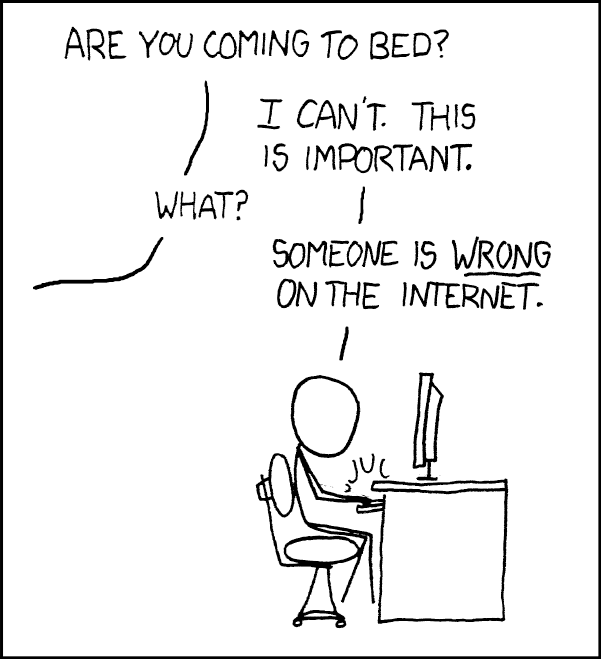
Compared to other gamblers, sports bettors trend even more male and — crucially — younger. There is a particular affinity among young people, especially young men, to view being right as the most important thing you can be. It’s the central animating force behind the “debate me” culture that has overtaken our TV news and sports channels and permeated down into social media. You’ve almost certainly seen this comic before, but it is no less salient today than when it was first drawn.
I came of age through the poker boom, and I even made a bit of money because of it. Some of my college friends did as well — one more notably than the rest of us. The poker boom exploded how and when it did for a number of reasons. The televised hole card cam gave an unprecedented look at everyone’s cards, creating suspense through the omniscience of the viewer. A Tennessee accountant turning a $86 ticket from an online qualifier into a $2.5 million first prize, all while having the last name Moneymaker, was no small factor. But the biggest, I believe, was that poker merged that same desire — to be right — with America’s most formative and enduring priority: making an easy buck.
The opportunity to use your ability to be right to make money might more aptly describe the modern version of the American dream. It’s driven Wall Street for years. Suddenly, it was accessible to anyone. But when the federal government shut online poker down, it didn’t quash the appetite for young men to get rich quick off nothing but their own wits. With the rise in popularity of fantasy sports — another chance to compete to be right, amongst your friends, and take their money — daily fantasy, and the eventual legalization of sports betting, feels almost inevitable.
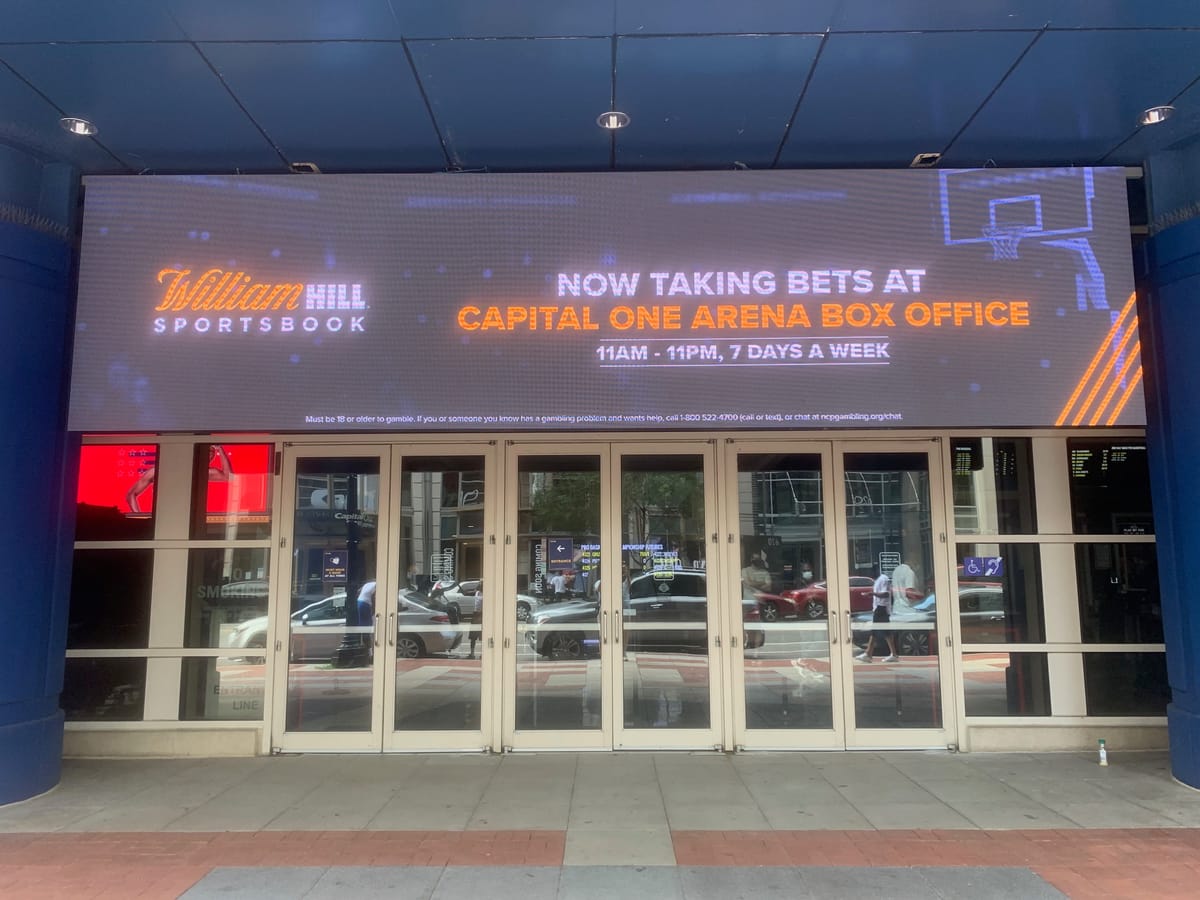
I had a front row seat to all of that, as well, as a reporter. I sat in a summit on Capitol Hill put on by Sportradar in November of 2017, six months before the Supreme Court overturned the law that had made sports betting illegal across much of the country. In the middle of one of the panels, Monumental Sports CEO Ted Leonsis stood up to insert himself into the conversation and essentially hijacked it to lay out his grand vision of turning Capital One Arena into a casino, where people would be laying a steady stream of in-game prop bets, on their phones, right from their seats.
That vision is no less horrifying now, more than eight years later, for having been realized than it was at that time. Gambling has long been a vice with significant friction to keep us from indulging in it. If I want to play poker, I generally have to drive with a wad of cash to a somewhat seedy casino or card room, something I have little to no desire to do anymore. Other legal social vices, like smoking, have become expensive and broadly socially frowned upon, tobacco companies barred from advertising on TV or near schools, smokers often huddling around corners like they’re committing a crime to indulge in a cigarette.
Meanwhile, sports betting gets celebrity endorsements. Parlays — the most predatory kinds of bets, where users are encouraged to chase long odds in the hopes of large payouts — are constantly pushed as promotions. The sharps, the pros who know what they’re doing and actually win money, are so frequently banned from sports books that there are entire articles online about how to not get banned for winning too much. But for the rest of the population, it’s all too easy to sign up, and wager, and lose, from your phone in a matter of seconds.
At least, that’s true in the states where sports betting is legal. Where it’s not, enter the prediction markets.
Every American needs to understand the scandals that are upending legal sports betting, the mechanisms of the emerging prediction markets, and how opportunity for insider trading could have a causative impact on upcoming major world events.
Let’s start with the inauspicious origin of prediction markets. In 2003, the Defense Advanced Research Projects Agency (or DARPA) within the Department of Defense created a futures market to try to predict political unrest. Once it was uncovered, it was roundly criticized as “betting on terrorism” and its creator, Admiral John Poindexter, was forced into retirement. Ironically, one of the first truly successful iterations of such a market in action was a site called Tradesports.com, which saw a market on Poindexter’s own resignation ebb and flow with insiders and the public reacting to real-world news, right up until the act.
It’s important to understand that, in a vacuum, these markets can be incredibly useful tools at essentially aggregating a combination of common wisdom and privileged information to deliver more accurate guesses than from individual experts. This makes some intuitive sense; the wisdom of crowds, and all that. But our current prediction markets aren’t weighted by the number of people betting one way — they’re weighted by the number of dollars doing so. And while you can bet on nearly anything, that includes events that individuals have direct control over, which almost begs for people to facilitate insider trading.
So far, we’ve already seen a mysterious account cash in for $400,000 by creating an account and suddenly betting that Venezuelan President Nicolas Maduro would soon be out of office, immediately before he was captured by the United States government. Very soon after that, White House Press Secretary Karoline Leavitt abruptly ended a press conference just 30 seconds before the line Kalshi had set (yes, really, there was a market for this), earning anyone who had bet the under 50 times their wager.
Unlike the betting scandals that have rocked the sports world, the insider knowledge that could be used to manipulate such markets — potentially to the benefit of administration officials and staff, no less — is completely transparent. But unlike the sports books, there is little monetary or reputational reason for prediction markets to care. Because unlike a sports book, which can absorb a big loss if too many bets come in on one side of a winning line, prediction markets just take a small cut of the action. So their entire motivation is simply to drive more action. The more money bet, the more money they make.
If that’s giving you a very Torment Nexus feeling about all this, well, congratulations, the Torment Nexus is here and its names are Kalshi and Polymarket.
You know who doesn’t seem to think it’s a bad thing, though? The once-obscure Commodity Futures Trading Commission (CFTC), which has decided to defend these markets against attempts by states that have banned sports betting to get rid of prediction markets as well. Why? Because the primary traffic for these markets in states like California and Texas, where sports betting is still illegal, is, well, sports betting. Prediction markets provide what seem to be a pretty transparent end around these states’ decisions around gambling.
Now might be a good time to point out that both Kalshi and Polymarket share a mutual strategic advisor, who joined each company last year: Donald Trump, Jr.
Perhaps the most absurd — and most telling — current market on Polymarket is for whether or not Jesus Christ will return to Earth before 2027. Yes, really. Now, while I’ve seen several people talk about how insane it is on its face (the total volume bet is over $32 million as of this week), what is often not mentioned is far more significant — that a second, speculative market appeared on the first market, which is set at a threshold of 5%. In simpler terms, if the betting on YES for Jesus’s return to Earth in 2026 exceeded 5% in a particular amount of time, a bunch of people would make money (and a bunch of others would lose it). In practical terms, all it would take is one person betting enough money on both markets simultaneously (more on the second than the first) to make money, with no regard to the potential reemergence of their lord and savior.
That secondary market failed. But the original market is still trading at 4%, meaning you could still profit on simply betting that Jesus will not return to Earth this year, at about the rate of a solid money market account. Or, you could throw your money into the abyss betting on Yes.
Sounds bad, but really, who cares how a fool is parted from his dollar, right? Sure. Now, let’s talk about elections.
Most of the handful of polls recently conducted in the Democratic Texas Senate primary show Rep. Jasmine Crockett leading Texas State Rep. James Talerico by 6-8 points (though one poll has Talerico up by a similar margin). And yet, the odds on Kalshi for this race favor Talerico, and had reached as high as 78% earlier this week.
This can’t be explained away, as the gap between the polls and the betting markets for the 2024 presidential election was, by so-called quiet Republican voters, as it’s a Democratic primary. And I don’t claim to have some crystal ball into the reason behind this, but here’s what I do know: money moves these markets. Those markets — especially when they’re broadcast on CNN (which struck a deal with Kalshi in December), or show up on Substack (which just inked a deal with Polymarket) — impact perception. And perception often drives action.
Or, to put it more bluntly, people like to vote for the candidate they think will win.
While there’s no such thing as a lead in elections until the votes are actually counted, there is absolutely movement based on perception. It impacts funding, both from big and small donors. It impacts media coverage and the way the candidates are discussed. If prediction markets begin to take even some of the weight away from polling in the way candidates are viewed and discussed, this could have a dramatic impact on the political landscape moving forward.
And since those numbers are driven entirely by money — by physical bets placed one way or another — these markets become just another unregulated way for those with the most money to wield it to influence our elections.
My first lesson in the sportswriting class that I teach is to ask my students: What is sportswriting? Once they’ve exhausted the full list of obvious things — game recaps, statistical analysis, feature stories, investigations — I ask them: What isn’t sportswriting?
There’s generally a pause. The Russia-Ukraine war? See the skeleton rider banned from the Winter Games for his helmet, portraying fallen comrades, or the fact that Russia itself is barred from competing. Economics? Anything from salary caps to the likely impending MLB lockout. Fashion? Have you seen what NBA players are wearing on their way to the arenas these days? Politics? Look, this newsletter can only be so long.
The point is straightforward: Everything is sportswriting.
I’ve also talked about how the sportsification of our politics has led to us seeing so many things in binaries, with no nuance. There are no red states and blue states (everything is just a different shade of purple), but presenting them that way makes for easily digestible TV. It also creates teams of us vs. them, which in turn creates winners and losers. That some people, including no small number of those in charge, insist on seeing the world through this zero-sum mentality, has led us to this deeply toxic moment.
Derek Thompson recently wrote about what he calls our “casino economy,” and how the degradation of so many aspects of our social fabric has hypercharged the get-rich-quick ideal in our society. If you’re not in on it, you’re getting left behind. It’s a message hammered home from every screen that occupies our attention.
So, then, if we accept that everything is sportswriting, and we accept Thompson’s proposition that we live in a casino economy, then I propose the following corollary: Everything is sports betting.
While Thompson isn’t wrong, the idea of a casino-based economy actually does not go far enough, in my view. The manipulation and encouragement of insider trading on prediction markets suggest the wagering aspect is merely a component of a larger, more depressing reality: that our economy is based entirely on scams. It’s a theory I’ve repeated before, but I’m working on developing more coherently. That’ll be the topic of a future Pretty Good.
Until then, try not to lose your shirt at the digital slot machine in your pocket. Because anybody can get lucky once, like betting on Arizona to win the national title. Since sports betting has been legal, I’ve mostly lost or won $5 or $10 at a time from my initial online deposit. I made a couple good bets for small amounts of money on the Super Bowl and won them, which was nice. But I got lucky in what was, hopefully, a legitimate contest. Being right doesn’t mean I was clairvoyant, or brilliant, or in any way special. And if you or I are willing to put money into markets that someone better connected than us can manipulate, we’re not just betting against chance — we’re paying the house for the privilege of scamming us.